
Missing Practices for Starting a Spiritual Village
The missing step between dreaming of community and actually living one

The dream of villages is everywhere right now.
Globally, people are trying to build intentional communities, co-housing projects, retreat centers, and land-based collectives. Groups gather around a shared vision: buy land together, build homes, grow food, raise children, and live in alignment with their values.
But most village projects overlook the most challenging aspect.
They try to build the physical village before the community.
Last month, I toured Radish, a residential village for sale in Oakland. I was impressed by the multiple homes, families, kids, and community house. They did it!
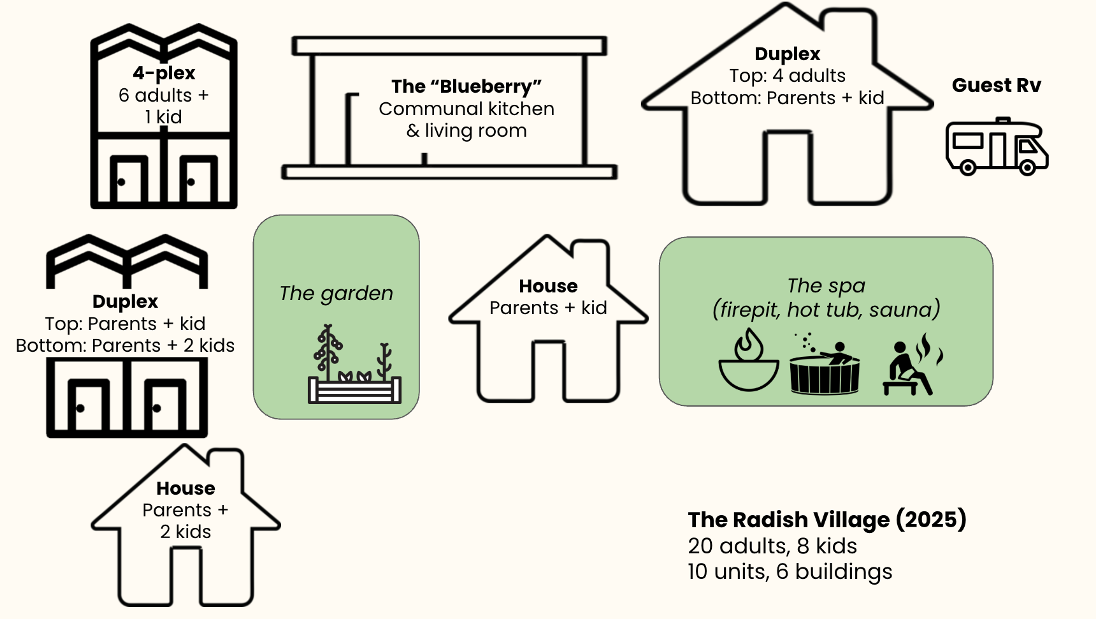
A fellow community weaver friend said something that has stayed with me. She wouldn’t join another residential community unless it was a spiritual one. I realized that was true for me too.
What makes a community a spiritual community?
My adult life has been about spiritual community. I’ve practiced in various spiritual communities. I ran a monastery and its monastery village. Afterwards, I gathered the Asheville Hearth community.
At my invitation, several spiritual friends moved to Asheville, NC. Last year, I led the attempt for my Asheville spiritual friends to buy land together. We almost closed on a mortgage, but it fell apart.
I felt hopeless. A few months later, nearly half the community moved away. The dream was on ice.
I missed something.
Time to go back to the drawing board.
This essay is my reflection of the past months. It clarifies the precursors to a spiritual village. My envisioning of a metamodern village center. Finally, my focus is on researching deep spiritual village practices.
What If the Village Started Outdoors?
In September, I went on a retreat-party camping week with a dozen friends on rustic land in California.
Low frills, minimal infrastructure, and an emergent schedule. What made it extraordinary were the people. Addictive habits fell away, and truth-telling and heart shares came easily.
I felt an ease and presence I associate with retreat containers, a feeling of deep rightness, of being at home, being my best self connected with others.
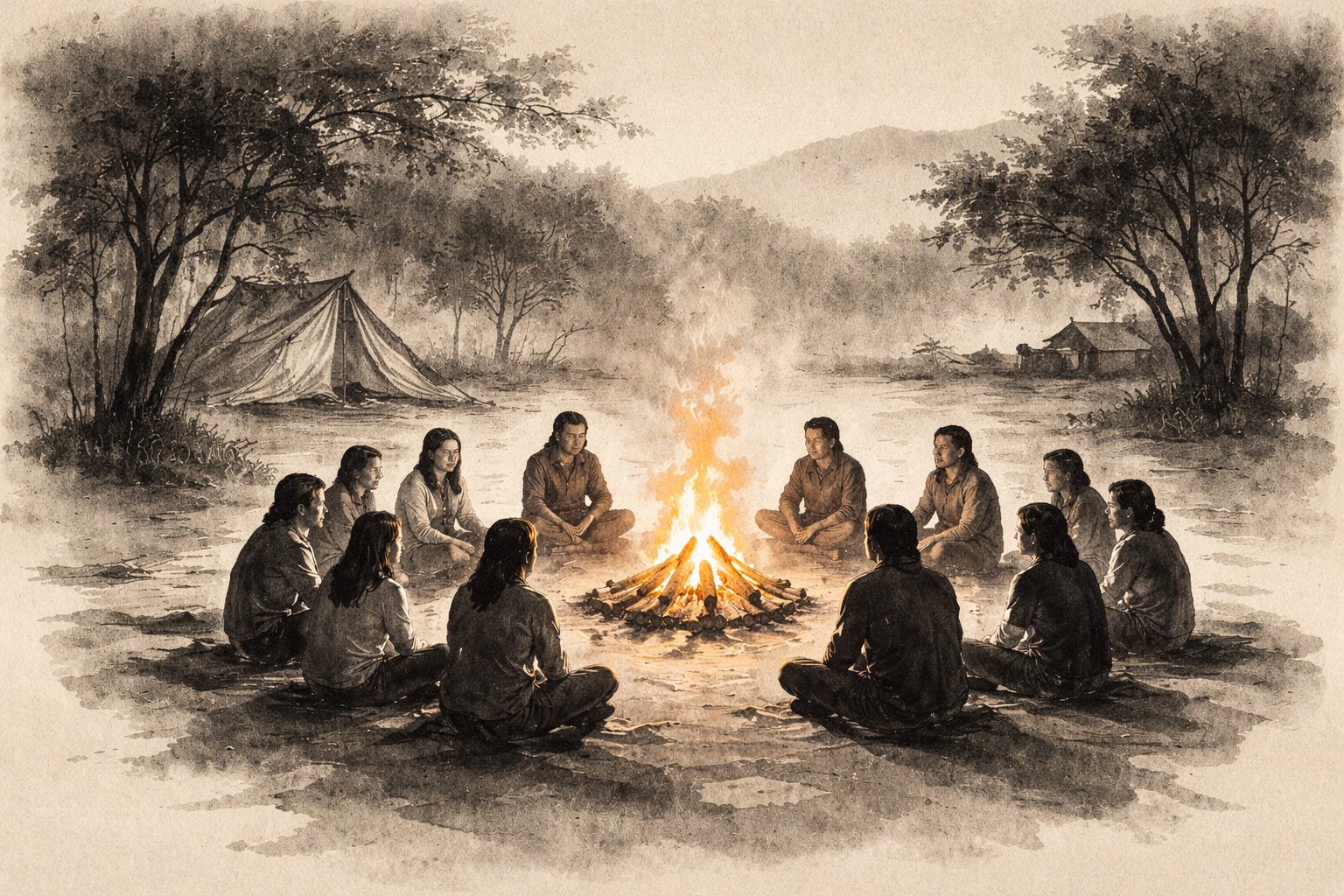
I looked around the raw land: the outdoor showers, kitchen, and tent sites. I realized I could build all this myself.
I thought starting my own center would be expensive. But, what if we had an outdoor-based, seasonal, low-maintenance center instead? At least as a prototype.
Why not create this back home?
I’ve built my own cabin. I ran a monastery and developed its guest programming. I understand utilities.
This center would be dedicated to creating deep community before an actual village. It would be a home for village practice to develop a strong community.
While pitching my outdoor metamodern village center idea, one question kept coming up: “What village practices lead to a village?”
From my monastery experience, I knew that the essence of community isn’t taught in models, beliefs, and words. It’s transmitted through daily experience, absorbed like a child absorbs language, through immersion rather than instruction. We need to generate and deepen that community field into village-level bonds.
Living Mandala Dharma House in Berkeley
In December, I lived at Living Mandala, a short-term dharma house experiment in Berkeley, for its final month. About ten people lived together with a daily morning schedule, weekly meetings, and frequent evening events.
Two friends organized this experiment, partly inspired by conversations with me and my Asheville house. I handed over our values documents and shared what I could about starting a dharma house.
The two houses were at different points on the same arc. Most members in Asheville had years of experience living together in a monastery. We already had community transmission. Less experienced members could absorb it from us.
I’d seen this at the monastery: the modeling in relationships and groups was the teacher, not explicit agreements or protocols. In Asheville, we needed space to reclaim personal sovereignty after intensive monastic life with its rigid schedules and structures. Over time, our group has worked on that polarity toward greater differentiation, finding partners, and making more friends in town.
Berkeley was the opposite starting point. Most residents had little or no prior experience in residential community. They might have done silent meditation retreats before, but living together is different.
Living Mandala had more structure than Asheville. It had morning practice periods, house roles like kitchen manager, and frequent public events and workshops. It felt like a residential center.
My original plan was to buy land and start a metamodern center, a place for practicing villaging together before an actual village. That felt like a significant intermediate step.
Watching the Living Mandala folks work through deep community life opened my eyes another step. The bottleneck wasn’t land or location. It was that the practices, principles, and relational capacities for spiritual village life don’t exist yet.
We were importing our experiences from the monastery or relying on tools like Relateful circles, but these weren’t sufficient for developing deep community life.
Now, I updated the steps. First, develop the village principles and practices before buying land. Then create temporary containers for people to develop deeply trusting, deeply committed relational ties through direct, lived experience.
A dharma house, a residency, or an online group are all just the canvas. But the people practicing together and learning to commune are the painting.
Metamodern Church Principles
What makes a community spiritual? I keep testing this question against the most vibrant example I know.
Several close Asheville friends have joined a newer, non-denominational Christian church with a strong sense of community. The church has young families, deep passion, and strong supportive ties. I’ve sung with them, felt the heart opening, and appreciate the earnest wholesomeness.
I believe the radical centering of Christ makes the community feel so passionate and coherent. It has the similar flavor to what the monastery’s emphasis on awakened leadership felt like. A sense of mission and importance worthy of commitment and safe to surrender into.
In the church, everything orients around Christ as a singular, non-negotiable axis. The singularity and sense of this being the most important thing, the thing everything else depends on.
The community has the downsides of common Christian churches: emphasis on belief over personal lived experience. The subtle fear of worldly versus church life, bypassing personal trauma towards faith and Jesus, and a single-solution mentality, common of many systems and traditions.
My friends hope to bring in more practices and perspectives (embodiment, relational practices, secure attachment, etc.) to help balance and enrich the church.
But, that doesn’t seem like my work. I don’t feel drawn towards the Christian church.
The question then becomes: what would provide that same centering force in a metamodern spiritual community?
I have a starting framework with four dimensions.
Immanent Divinity
Everyone carries truth and the sacred within them. Spiritual practice deepens our daily realization of this. The spiritual community’s work is to transmit this view as part of its culture.Tradition as Resource
Traditions are a sacred resource but not end points. The point is not to imitate Christ or the Buddha. Traditions provide a path and past learning to realize and apply those truths to our evolving reality.
Historical Urgency
On a personal level, we are always in a period of change and unknown. On a historic, cultural level, we are living through a civilization transition that asks us to take seriously our participation in our lives and the world.
Truth, Love, and Responsibility are Real.
We begin with the most basic premise of religion that truth, love, and responsibility are real and important. It’s the antidote to nihilism and relativism.
A more open framework like the one I’m describing might be too diffuse to generate the alignment that makes the community feel sacred and coherent.
But it’s something I’ll research next.
Teaching Residency at the Nectary
Tomorrow, I’m joining the Nectary in Washington, DC, a two-month residential experimental laboratory in its second year. About fifteen experienced practitioners are living together to explore the frontier of metamodern practice, soul work, relational depth, and sacred economy.
Think of it as a yin-based pop-up monastery: contemplative, experimental, and exploring the frontier of deep community.
My work will focus on the Hearth, the home-village dimension of communal life, internally. I’ll work with other residents to test a community archetypes hypothesis, explore Hearth village practices, and develop our collective trust and intimacy.
I look forward to publishing and sharing more on those results.
I’ll be leading Stillness Comes Easier Together, a public, day-long meditation retreat on Saturday, March 28, focused on deepening safety via relationship. The premise is simple: many modern people carry a background hum of anxiety, stress, loneliness, and self-doubt. Because of this unresolved material, the turn toward presence and direct experience can be challenging. Meditation is often taught through willpower, forcing, or dissociation, muscling our way into stillness.
This retreat takes a different approach. The first priority is creating genuine safety, trust, and attunement in the social field with skilled facilitators. From that deep relational safety, from a foundation of secure attachment rather than effortful striving, participants can settle into presence naturally. Melting rather than forcing.
If you’re interested, I’d love to have you there.
The hope is that containers like Asheville Hearth, Living Mandala, and Nectary can serve as laboratories for village life. There, precursor capacities get researched, practiced, and refined before buying land to build permanent ties.
My current steps:
Gather in spaces to tend to the communal hearth’s soul with other dedicated fellows.
Research the principles and practices that develop spiritual community and deep ties based on connection to the sacred and commitment to truth and one another.
Share those principles and practices with broader audiences.
From that larger dataset of people and relational bonds, allow the creation of dharma homes, metamodern centers, and a spiritual village.
Moving forward
I’m drawn back to the same question: what does a deep spiritual community require of us?
It takes a village to start a village.
Before the physical village, we need to plant the seeds of the village bonds within and between each other.
This includes the personal trauma healing work, the shadow pattern breaking, the alignment with vow, and more.
Over the next two months, I’m following that thread at the Nectary and look forward to sharing what emerges.
If this work resonates, there are several ways to participate:
one-on-one emotional coaching (schedule a free intro session).
Tuesday night circles through Relateful (zoom-based).
Trustworthy Ground Together, a day-long meditation retreat in Washington DC on Saturday, March 28.
Relational Mindfulness daylong at Greatwoods Zen, Charlotte, April 5th.
These are the patient efforts of building the capacities that a metamodern spiritual community will rest on.
If you’re in Washington DC between March 15 and May 15, join us at the Nectary!
I love what you’re saying about Christ as the center. I have the village technology, 3 principles, 4 premises, they help any community live in peace if just one person is following them. but the center really matters. I can’t say what it “should” be, but I’ll say that if the center is relationships or relationship health, that falls apart faster than anything.
From my experiences I found that there is something spiritual that holds a group of people together that often went unstated. It loosely revolved around individuals having a sincere desire to get along and be of service and be in support of each other. I think that a large part of the success of a community is in finding the people who will practice this lived desire and crafting a specific mission together. I highly recommend “Creating A Life Together” by Diana Leafe Christian that is a very practical guide to creating a community. https://newsociety.com/book/creating-a-life-together/